


Dr. Lalit Rajpal
Confidence Beauty Redefined
Transforming lives through artistry, expertise, and care with global standards of excellence.

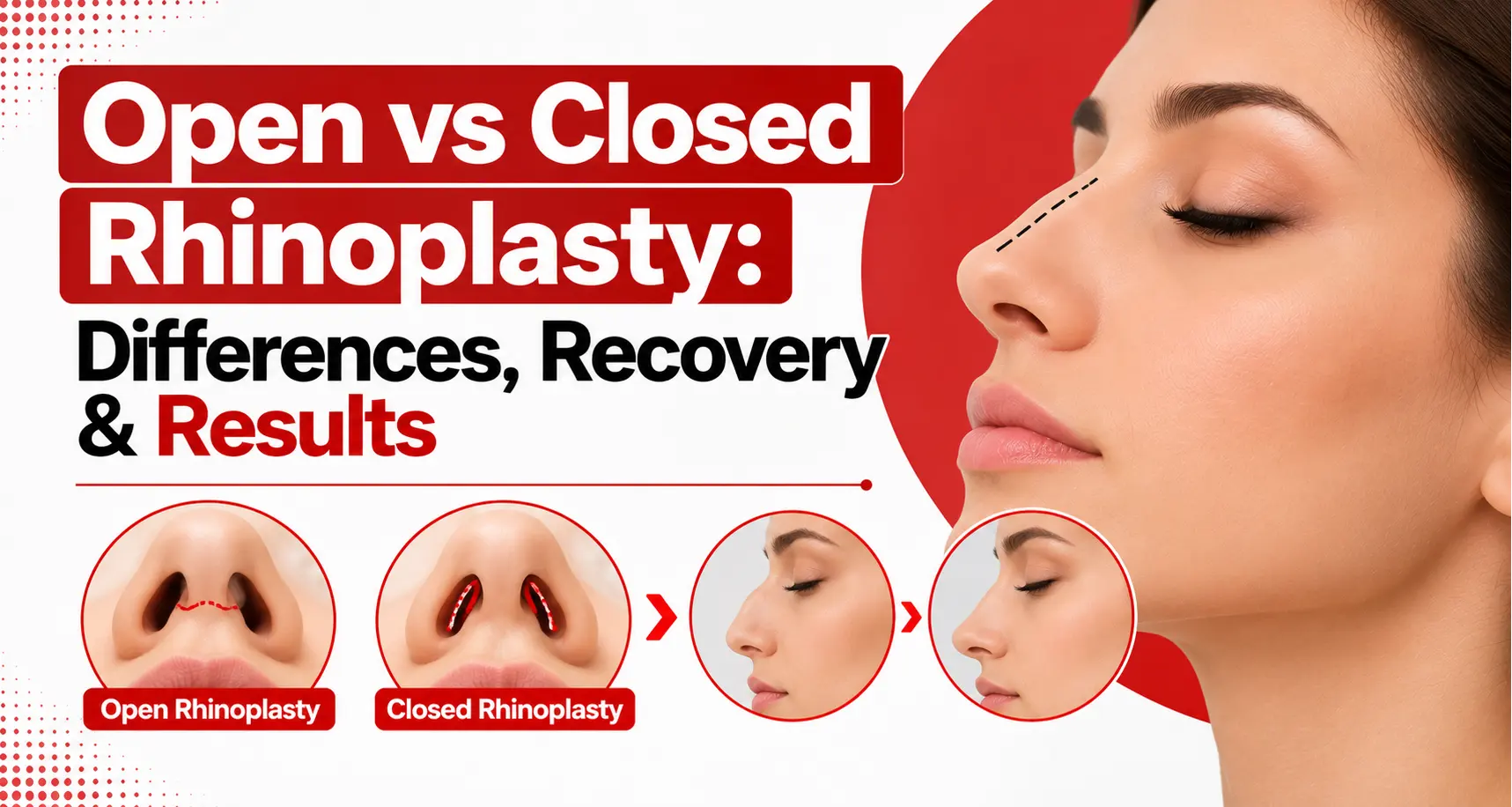
Open vs Closed Rhinoplasty: Differences, Recovery & Results
Key Highlights
- Get a grasp of how open and closed rhinoplasty differ in terms of surgical access and incision sites.
- Find out which procedure is better for minor or major nasal alterations.
- Compare their scarring, swelling, and recovery periods.
Find out what to expect during recovery. - Get an understanding of how nasal outcomes are achieved.
- Understand the reasons for choosing one technique over the other.
Table of Contents
- What Is the Difference Between Open and Closed Rhinoplasty?
- How is Open Rhinoplasty Performed?
- When Is Open Rhinoplasty Considered?
- How Does Closed Rhinoplasty Work?
- Which Technique May Suit Simpler Nasal Corrections?
- What Are the Main Distinctions Between the Techniques?
- What Should You Expect During Recovery?
- How Long Does It Take to See the Final Results?
- Final Words
The effects of rhinoplasty include the restructuring and resizing of the nose. However, the method used plays an important role. Open vs closed rhinoplasty are two methods that are similar in all but one thing: the incision.
For an open procedure, the surgeon will make an incision in the columella while for the closed, the surgeon will make an incision internally in the nostrils. What is best depends on the extent of the restructuring, nasal anatomy, previous surgeries and surgical method.
An understanding of how each method works will assist a patient to have a more productive discussion before making any decision regarding surgical options for their nose.
What Is the Difference Between Open and Closed Rhinoplasty?
The open and closed rhinoplasty difference involves incision placement and surgical exposure. Open surgery provides visibility of nasal structures, whereas closed surgery works through internal openings without an external incision.
Rhinoplasty can address appearance and selected functional concerns. Common goals include:
- Refining the tip or bridge
- Correcting visible asymmetry
- Changing nasal proportions
- Repairing trauma-related changes
- Improving selected breathing concerns
The procedure is planned around the nasal framework and required change. Examination helps determine suitable access. A plastic surgeon in Mumbai can discuss anatomy, previous procedures, expectations, and healing during a consultation before surgery and recovery.
How is Open Rhinoplasty Performed?
Open rhinoplasty makes an incision on the columella where the nasal skin can be elevated easily to give the surgeon access to the bone and cartilage underneath.
The incision on the outside of the nose provides the surgeon a view of the cartilage, bone, and other supporting structures. After lifting the skin, planned reshaping can be performed under visual control.
Possible surgical steps include:
- Modifying cartilage
- Reshaping nasal bones
- Refining the tip
- Adjusting bridge contours
- Adding structural support when required
The incision is carefully closed at the end. Scar appearance differs between patients and changes as healing progresses.
When Is Open Rhinoplasty Considered?
Open rhinoplasty is often chosen for complicated reshaping, large degree of asymmetry, structural reconstruction, intricate tip work, changes due to trauma, and revision surgery where greater exposure is required due to changed nasal anatomy.
Greater access can help when several nasal structures require correction. Open surgery may therefore be considered for:
- Complex deformities
- Marked asymmetry
- Trauma-related changes
- Detailed tip reconstruction
- Revision procedures
Previous surgery can alter anatomy and create scar tissue. Direct exposure can help the surgeon assess these specific areas safely. The approach depends on examination, goals, complexity, and anatomy. Rhinoplasty in Mumbai follows the same approach selection principles.
How Does Closed Rhinoplasty Work?
In closed rhinoplasty, all incisions made during the procedure are done within the nostrils. The surgeon then accesses the nasal structure via these incisions, performs necessary adjustments, and finally closes the incisions made internally.
The internal approach keeps the incision away from visible skin. The surgeon works through the nostrils to reach structures requiring modification.
Potential advantages include:
- No external columellar incision
- No visible external surgical scar
- Less disruption of overlying nasal skin
- Suitable access for selected corrections
Closed surgery can suit limited changes that do not require broad exposure. Its smaller working field can make complex corrections less suitable.
Which Technique May Suit Simpler Nasal Corrections?
Closed rhinoplasty may suit selected patients needing limited reshaping, such as modest bridge changes or carefully planned adjustments, while open surgery can provide broader access for more extensive individual corrections.
Patients needing modest changes may be candidates for a closed approach. Examples can include:
- Small bridge adjustments
- Limited contour changes
- Selected tip modifications
- Minor cosmetic refinements
Open surgery may be chosen when broader exposure is needed. The choice is not based solely on scar preference because anatomy and the required correction also matter. A consultation will help clarify the practical differences between closed vs open rhinoplasty.
What Are the Main Distinctions Between the Techniques?
The differences between open rhinoplasty vs closed rhinoplasty are mainly about incision, visibility, access, swelling, and recovery time. The open rhinoplasty is more visible, while the closed rhinoplasty does not even have an incision mark outside.
| Factor | Open | Closed |
| Incision | Columella | Nostrils |
| Scar | Possible | None |
| Visibility | Broader | Limited |
| Typical use | Complex | Selected |
| Swelling | More initially | Less initially |
| Access | Extensive | Restricted |
Long-term appearance depends on surgical planning, anatomy, healing, and the correction performed.
What Should You Expect During Recovery?
The open vs closed rhinoplasty recovery process commonly includes swelling, bruising, congestion, and temporary discomfort. Open procedures may have more initial swelling, although healing varies considerably between individuals initially typically.
A common question is: Is rhinoplasty painful? Discomfort is generally managed through medication and postoperative care, although early healing can involve swelling, bruising, congestion, and tenderness.
Patients may receive a nasal splint during early healing. Typical guidance includes:
- Protecting the nose from impact
- Following wound-care instructions
- Avoiding strenuous activity until cleared
- Attending scheduled follow-up visits
Open procedures can have more swelling initially, while healing remains variable.
How Long Does It Take to See the Final Results?
The rhinoplasty recovery time is different for everyone, but early swelling usually improves over the course of weeks, and subtle swelling takes up to months to improve. Nasal shaping may take anywhere between six and twelve months or even longer.
Early results are visible due to swelling, but the process goes on gradually. One possible timeline for improvement might be:
- About one week: Early splint removal
- Two to three weeks: Bruising usually decreases
- One to three months: Much swelling subsides
- Six to twelve months: Increasingly stable definition
People considering rhinoplasty cost in India should discuss the complete surgical plan and expenses during consultation. Price varies according to procedure complexity and hospital arrangements.
Final Words
Open and closed rhinoplasty can both reshape the nose, but the appropriate approach depends on anatomy, correction complexity, previous surgery, and the surgeon’s assessment. Patients should know that recovery time and final nose shape vary by individual.
Dr. Lalit Rajpal, a trusted cosmetic, hair transplant and plastic surgeon in Mumbai, uses a systematic and patient-specific approach and has received extensive training in rhinoplasty surgery. In addition to this, he has also worked as a consultant at Royal Bahrain Hospital, Bahrain, for five years.
For any questions related to your nose and the surgical technique, visit Dr. Lalit Rajpal.
About Author

Dr. Lalit Rajpal
Dr. Lalit Rajpal, MBBS, MS, MCh (Plastic Surgery), is a board-certified plastic, aesthetic, and hair transplant surgeon based in Mumbai with over 12 years of experience. Known for his precise and patient-centered approach, he combines advanced surgical techniques with an artistic touch to deliver natural and precise results. Dr. Lalit is a member of leading national and international plastic surgery associations and is committed to providing personalized, ethical, and high-quality care to every patient.
Latest Post
- Understanding The Difference Between Gynecomastia And Chest Fat
- Rhinoplasty Cost In India: A Complete Breakdown
- Hair Transplant Cost in India: Find Out What You’ll Really Pay!
- Hair Transplant Side Effects
- How to Reduce Breast Size Naturally and With Surgery
- Is Hair Transplant Safe? Complete Safety Guide
- Right Age for Hair Transplant: Minimum Requirement, Risks & Benefits

Dr. Lalit Rajpal is a leading Plastic, Cosmetic, and Hair Transplant Surgeon based in Mumbai. With over 10+ years of experience, he has successfully performed 300+ cosmetic surgeries and 420+ reconstructive surgeries.



Treatments
©2026 All Rights Reserved Dr. Lalit Rajpal Aesthetic Clinic Managed by Vbind