


Dr. Lalit Rajpal
Confidence Beauty Redefined
Transforming lives through artistry, expertise, and care with global standards of excellence.

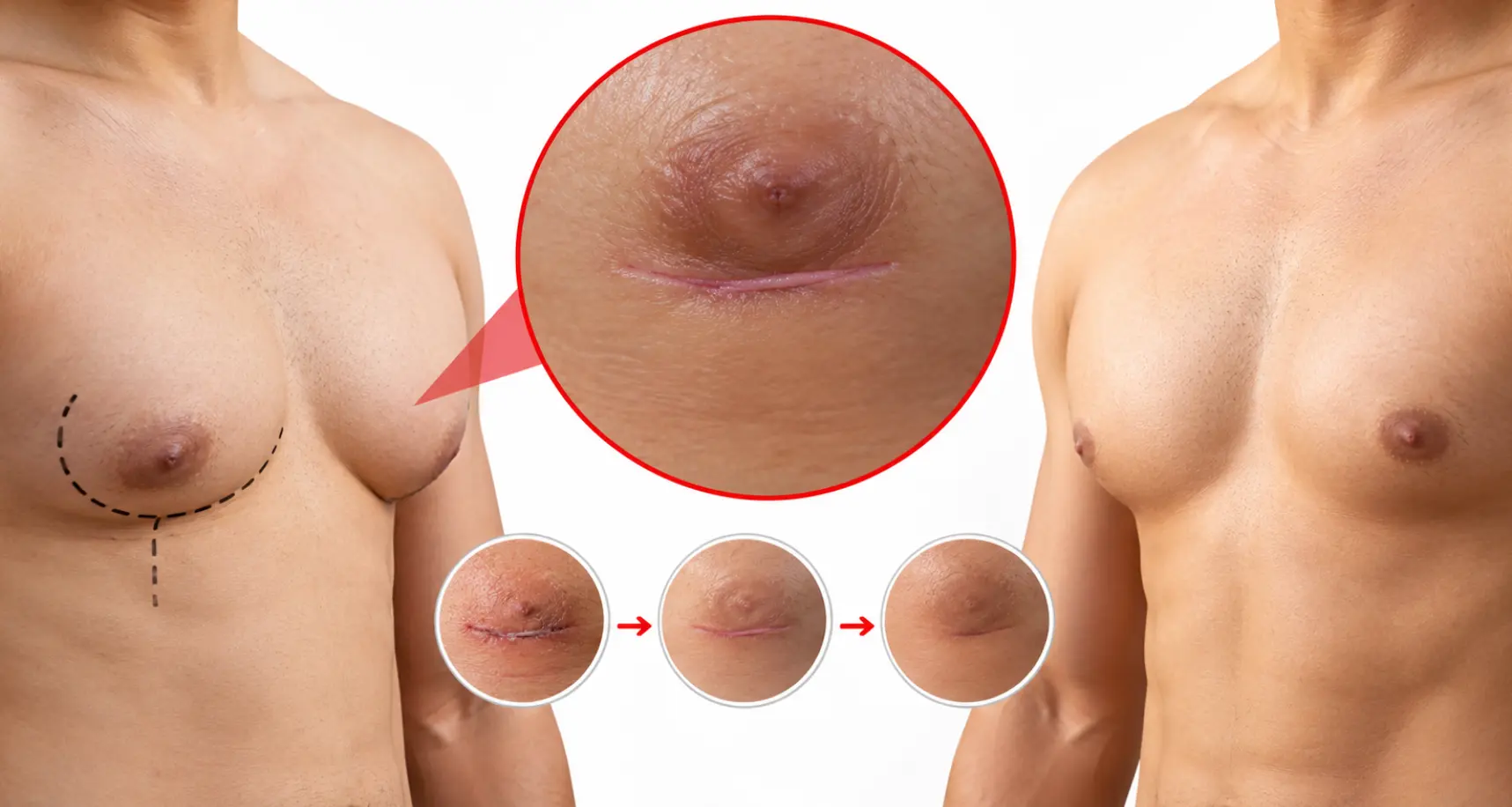
Does Gynecomastia Surgery Leave Scars? Healing & Recovery
Key Highlights
- Gynecomastia surgery can leave scars, but their size and location vary by technique.
- Liposuction usually creates tiny entry-point marks.
- Gland removal may require an incision around the areola.
- Loose skin can require longer chest scars.
- Scar colour, firmness, and texture change during healing.
- Proper wound care can support healthy scar maturation.
- Individual skin type and healing affect the final appearance and overall visibility.
Table of Contents
- Why Does Gynecomastia Surgery Scar Formation Happen?
- Where Are Gynecomastia Surgery Scars Usually Placed?
- How Long Does Gynecomastia Surgery Scar Healing Time Usually Take?
- What Can Make a Scar More Noticeable?
- Can Exercise Remove the Need for Surgery or Scars?
- How Can You Help Gynecomastia Scars Heal After Surgery?
- When Should You Contact Your Surgeon During Gynecomastia Surgery Recovery Time?
- How Long Does It Take to See the Final Results?
- Wrapping Up
Scarring is a common issue that is faced by men when they consider the possibility of undergoing chest contouring procedures. Scar formation will be inevitable when there is an incision made during any type of surgery.
However, the result is unique to each individual. For people asking, does gynecomastia surgery leave scars? Yes, but the extent of the scar depends on the affected tissues, the method used in the surgery, the patient’s skin, among other factors.
Some patients may develop small scars from liposuction, while others can develop a line that circles the areola or scars from skin removal procedures.
Why Does Gynecomastia Surgery Scar Formation Happen?
Yes. Surgery creates an opening to remove glandular tissue, fat, or excess skin. The resulting mark may be tiny or longer, depending on the correction required for your chest.
Gynecomastia may involve glandular tissue, fat, loose skin, or a combination. Surgical access must match the tissue.
- Liposuction removes excess fat through small entry points.
- Excision removes firm glandular tissue.
- Skin removal treats significant laxity.
The plan should follow the chest examination.
Where Are Gynecomastia Surgery Scars Usually Placed?
The gynecomastia surgery scar location depends on the tissue treated and surgical method. Liposuction usually leaves small openings, gland removal may use an areolar incision, and skin removal creates longer lines that are more visible.
Incision placement balances access with visibility. Small openings may sit near less noticeable areas. An incision along the lower areolar border can blend with the colour transition.
Longer incisions may be needed when loose skin requires removal. The pattern depends on excess and nipple position.
Approach | Scar pattern | Tissue addressed |
Liposuction | Several tiny marks | Fat |
Excision | Areolar line | Gland tissue |
Skin removal | Longer line or anchor pattern | Excess skin |
Combined | More than one pattern | Fat, gland tissue, skin |
How Long Does Gynecomastia Surgery Scar Healing Time Usually Take?
Small liposuction openings usually leave short marks, while gland excision can leave an areolar line. Larger skin removal may produce vertical, horizontal, or anchor-shaped scars across the chest area overall.
The appearance of gynecomastia scars after surgery can change during healing. An incision may look red, pink, brown, or darker than the skin. Firmness, tightness, or itching can occur.
Changes include:
- Early weeks: the wound closes.
- Following months: colour and firmness settle.
- Later months: the scar becomes softer and flatter.
Scar maturation is individual and can continue for many months.
What Can Make a Scar More Noticeable?
Scars tend to soften and lose colour over time as part of the natural healing process. It takes several months for all these features to mature, hence an initial scar formation does not necessarily signify the final result.
Scar appearance is determined by skin colour, genetic factors, size of the incision, tension of the wound, and complications. The presence of previous thick or keloid scars may be important.
Nicotine and smoking can negatively impact healing. Stretching, vigorous physical activity before approval, infections, swelling, and sun exposure can affect appearance.
Tell the surgeon about:
- Previous raised or thick scars
- Medicines and supplements
- Smoking, tobacco, or nicotine use
- Previous chest surgery
These details help set expectations.
Can Exercise Remove the Need for Surgery or Scars?
Some of the factors that affect gynecomastia surgery scars are genetics, skin colour, the size of the cut, healing of wounds, infections, smoking, sunburn, and stretching.
Understanding the difference between gynecomastia and chest fat helps explain why not all cases of gynecomastia can be solved through exercise. Weight loss can help to manage fat. However, the gland is not going to go away with exercise.
Chest exercises can strengthen pectoral muscles and alter shape. They cannot remove:
- Firm gland tissue
- Significant loose skin
- Persistent enlargement beneath the nipple
An examination helps identify the cause of fullness. The treatment should be done on the basis of these results.
How Can You Help Gynecomastia Scars Heal After Surgery?
While exercises will lower total body fat and make chest muscles more defined, they cannot eliminate the firm glandular tissue or excess skin that causes gynecomastia in many people.
Postoperative care is done according to the surgeon’s recommendations. General measures include:
- Keeping dressings clean and changing them as directed
- Wearing the recommended compression garment
- Avoiding heavy lifting until cleared
- Limiting pressure and stretching around the wound
- Protecting healing skin from direct sunlight
Silicone gel or sheets may be considered after the wound has closed. They may help some scars become less thick or firm, but they do not erase scar tissue.
Do not apply products to an open or infected wound. Follow-up appointments help monitor the process of gynecomastia scar healing.
When Should You Contact Your Surgeon During Gynecomastia Surgery Recovery Time?
In most cases, care entails compliance with the instructions on dressing, protection of the incision, use of compression as recommended, avoiding excessive physical activity, and consideration of silicone products once the wound heals completely.
Some swelling may occur in the process of healing. Worsening symptoms need prompt assessment.
Contact the clinic for:
- Increasing redness or warmth
- Pus or unusual drainage
- Persistent bleeding
- Wound separation
- Fever
- Pain or swelling is increasing
Breathlessness, chest pain, fainting or a very weak feeling should be addressed at once.
Any new lumps, nipple discharges, bleeding, skin dimpling or sudden changes in one side of the body should be checked. A consultation after gynecomastia surgery in Mumbai could provide information on incision plan, treatment, scar formation, and recovery requirements.
How Long Does It Take to See the Final Results?
The rhinoplasty recovery time is different for everyone, but early swelling usually improves over the course of weeks, and subtle swelling takes up to months to improve. Nasal shaping may take anywhere between six and twelve months or even longer.
Early results are visible due to swelling, but the process goes on gradually. One possible timeline for improvement might be:
- About one week: Early splint removal
- Two to three weeks: Bruising usually decreases
- One to three months: Much swelling subsides
- Six to twelve months: Increasingly stable definition
People considering rhinoplasty cost in India should discuss the complete surgical plan and expenses during consultation. Price varies according to procedure complexity and hospital arrangements.
Wrapping Up
Scars are a part of any surgery, but the size and look of the scar will vary according to several parameters like tissue type, type of the incision made, skin type, and the gynecomastia surgery scar healing time.
Gynecomastia surgery can use the incision for liposuction, an areola incision, or long incisions if there is an excess of skin to remove. Proper care of the wounds and follow-up is important for proper recovery.
Dr. Lalit Rajpal, a reliable plastic surgeon in Mumbai has more than 10 years of experience and five years of service at Royal Bahrain Hospital. Discuss your chest concerns, expected scar pattern, recovery plan, and treatment options with Dr. Lalit Rajpal during a consultation for your needs.
About Author

Dr. Lalit Rajpal
Dr. Lalit Rajpal, MBBS, MS, MCh (Plastic Surgery), is a board-certified plastic, aesthetic, and hair transplant surgeon based in Mumbai with over 12 years of experience. Known for his precise and patient-centered approach, he combines advanced surgical techniques with an artistic touch to deliver natural and precise results. Dr. Lalit is a member of leading national and international plastic surgery associations and is committed to providing personalized, ethical, and high-quality care to every patient.
Latest Post
- Understanding The Difference Between Gynecomastia And Chest Fat
- Rhinoplasty Cost In India: A Complete Breakdown
- Hair Transplant Cost in India: Find Out What You’ll Really Pay!
- Hair Transplant Side Effects
- How to Reduce Breast Size Naturally and With Surgery
- Is Hair Transplant Safe? Complete Safety Guide
- Right Age for Hair Transplant: Minimum Requirement, Risks & Benefits

Dr. Lalit Rajpal is a leading Plastic, Cosmetic, and Hair Transplant Surgeon based in Mumbai. With over 10+ years of experience, he has successfully performed 300+ cosmetic surgeries and 420+ reconstructive surgeries.



Treatments
©2026 All Rights Reserved Dr. Lalit Rajpal Aesthetic Clinic Managed by Vbind